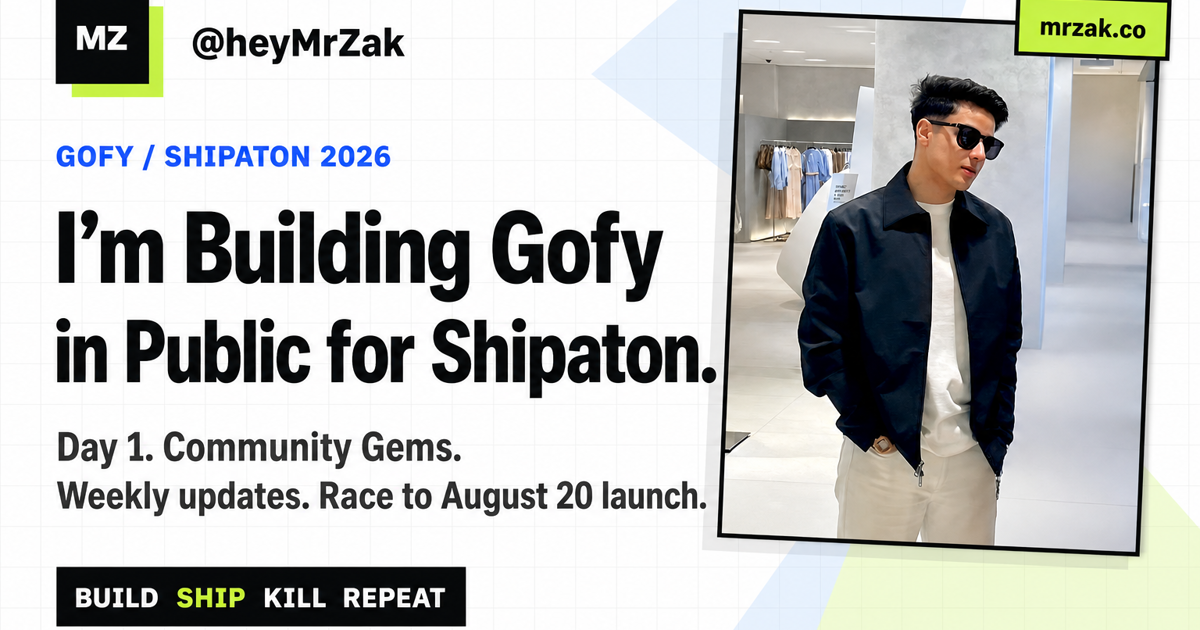
Hi, I'm Zak.
If you don't know me, I'm building in public and sharing what I learn along the way. I also share tips about building apps, AI-assisted development, and everything that happens between having an idea and actually shipping it.
You can follow me on X: @heyMrZak.
And now I'm starting something a little different.
I'm going to participate in RevenueCat Shipaton 2026.
What is Shipaton?
If you haven't heard about it, Shipaton is a global app-building competition hosted by RevenueCat.
The challenge is pretty simple: ship a brand-new app during the Shipaton window and see what you can do with it.
The 2026 submission period runs from August 1 to September 30, 2026. The competition has a $100,000 Grand Prize, plus several other category prizes. RevenueCat says the total prize pool has grown to more than $700,000 in cash, with more than $1 million in total prizes.
This is my first Shipaton.
And honestly, I have no idea how far I can take this.
But that's exactly why I want to document it.
The idea: Gofy
The app I'm bringing to Shipaton is called Gofy.
Gofy has been in my head for more than five months.
I had the idea for a while, but at some point I decided:
Enough thinking. I need to build it.
Then I received an email about Shipaton.
I looked at the competition.
I looked at the deadline.
I looked at the prize.
And I thought:
Why not?
So now I'm trying to turn Gofy from an idea into a real mobile app as fast as I can.
So what is Gofy?
The easiest way I can explain it right now is:
Gofy is a community-powered map for discovering things worth seeing in the real world.
Not just restaurant deals.
Not just tourist attractions.
Not just another map with thousands of places that never change.
I want Gofy to become a place where people can discover what is actually interesting around them.
A hidden café.
A new restaurant.
An event.
A beautiful location.
A shop.
A party.
A place nobody knows about yet.
Something happening tonight.
A local recommendation.
Basically, if someone thinks:
"You should see this."
I want there to be a place for that on Gofy.
I call these discoveries Gems.
The problem I keep thinking about
The map itself isn't the difficult part.
The difficult part is:
How do you keep a community-powered map alive?
How do you get people to continuously add new Gems?
How do you get people to update old information?
How do you stop the map from becoming another database that gets created once and then slowly becomes outdated?
And most importantly:
Why would people spend their time contributing?
That's the part I'm trying to solve.
My idea: make the community part of the system
I don't want Gofy to depend entirely on me adding places.
I want the community to help build the map.
Someone discovers something interesting.
They add it.
Other people discover it.
Someone actually goes there.
They can verify the Gem after spending enough time at the location.
And eventually, the people who contribute valuable information can participate in Gofy's earning system.
That's the idea I'm experimenting with.
I don't know yet if it will work.
That's the point of building it.
Why I think the earning system could matter
Most platforms ask people to create content because the platform benefits from it.
Social media is a good example.
People create posts.
People create videos.
People create communities.
The platform grows because users create the content.
I want to experiment with a different question:
What if the people who keep a local discovery map useful can also benefit from the value they create?
That's where Gofy's Premium community comes in.
The current idea is that Premium members can become eligible to participate in the earning system.
For example, a Premium member could have a limited number of active Gems and earn from qualified activity around the Gems they create.
They can also discover and verify Gems themselves.
A verification isn't simply opening a Gem and pressing a button.
The idea is that the user has to actually spend time at the location before the verification qualifies.
I'm still building the exact economics and anti-fraud system.
And I expect this part to change a lot once real people start using Gofy.
The first problem I already see
Of course, the second you say:
"People can earn money."
you have to think about abuse.
What happens if someone creates ten accounts?
What happens if someone has ten phones?
What happens if someone creates hundreds of useless Gems?
What happens if people try to fake location activity?
What happens if someone creates a Gem and then gets their friends to fake verifications?
I don't want to build a reward system that can be drained in five minutes.
So I'm already thinking about limits and verification.
For the first version, I'm considering things like:
- A maximum of 10 active Gems per account
- A maximum of 5 reward-eligible verifications per day
- A minimum amount of time spent at the location
- No reward for verifying your own Gem
- Pending rewards before money becomes withdrawable
- Account and device behavior checks
- Location and activity checks
I'm sure this will evolve.
But I would rather think about these problems now than discover them after someone exploits the system.
I need to ship fast
This is probably the biggest challenge for me.
I'm building Gofy with React Native and using AI heavily during development.
I'm using AI coding tools to move faster, but AI doesn't magically build a product for you.
You still have to decide:
- What to build
- What not to build
- What the user experience should be
- What the architecture should look like
- What can wait
- What needs to work perfectly
- What is actually worth shipping
And Shipaton makes this even more interesting because there is a deadline.
My target is:
August 20, 2026
That's when I want Gofy to be publicly launched.
That gives me only a short amount of time to get the first version ready.
So I'm trying to follow one rule:
Ship first. Improve after.
RevenueCat itself recommends shipping the 1.0 version quickly and then pushing updates during the competition.
Week 1: the map already has more than 100 Gems
Before the app is even finished, I've already started working on the content side.
In the first week, I got more than 100 Gems into Gofy.
That might not sound huge.
But for me, it answers one important question:
Can I actually start building the map before the app is finished?
The answer is yes.
Now the next question is much harder:
Can I get other people to care about it?
That's what I'm going to find out.
How I'm building Gofy
I already have the design direction.
I'm using AI to help with the design and development, but I'm still making the decisions and adding my own touch.
For development, I'm currently using tools including:
- React Native
- Claude
- Claude Code
- Antigravity
- AI-assisted development workflows
I'm also working on the backend, subscriptions, location functionality, Gems, verification, and the systems that will eventually connect all of this together.
It's a lot.
Which is exactly why I'm trying not to overbuild the first version.
I'm not sure Gofy will win
I want to be honest about that.
There are going to be a lot of builders participating in Shipaton.
Some people will have better designs.
Some will have bigger audiences.
Some will have more money.
Some will build faster than me.
And some apps will probably be much better than Gofy.
The Grand Prize is based on growth and traction, so building the app is only the beginning.
That's actually what makes this interesting.
I don't want this series to be:
"Look at my amazing app."
I want it to be:
"Let's see if I can actually make this thing work."
What I'm going to share here
I'm going to keep coming back to this article and update it as I go.
Every week, I'll add what happened.
Not only the good stuff.
The failures too.
I'll share:
- What I built
- What I changed
- What broke
- What users said
- What I learned
- How many people joined
- How many people used Gofy
- What worked for growth
- What didn't work
- What I'm doing next
- How Gofy's monetization develops
- And eventually, how Gofy performs during Shipaton
I also want to share the AI development side because I'm learning a lot about what actually works when building a real mobile app with AI.
I've already written about vibe coding and building apps with AI, and I'll link those articles here as this series grows.
The real goal
Of course, winning $100,000 would be insane.
I'm not going to pretend I don't want that.
I absolutely do.
But there's another goal.
I want to see if I can take something that existed mostly in my head for months and turn it into:
a real app → real users → a real community → real revenue.
And if Gofy can actually make people discover something they wouldn't have found otherwise, then I'll consider that a win too.
So this is Day 1.
The app isn't finished.
The community doesn't exist yet.
The earning system isn't proven.
And I still have a lot to build.
But the idea is no longer just in my head.
Gofy is being built.
And now I'm going to find out what happens when I actually ship it.
Follow the journey
I'll update this article every week during Shipaton with what happened, what I learned, and what I'm changing.
If you want to follow Gofy's journey, you can also follow me on X at @heyMrZak.
And if you want to see what I'm building, check out Gofy.
Next update: getting Gofy ready for the August 20 launch.
Let's see how far we can take it.